* // Reading Time: 7 minutes
As the end of 2025 approaches, Qualcomm will be present in the AI datacenter space from 2026 onwards. Can it lead the way in another AI niche instead of following Nvidia, AMD & Broadcom?
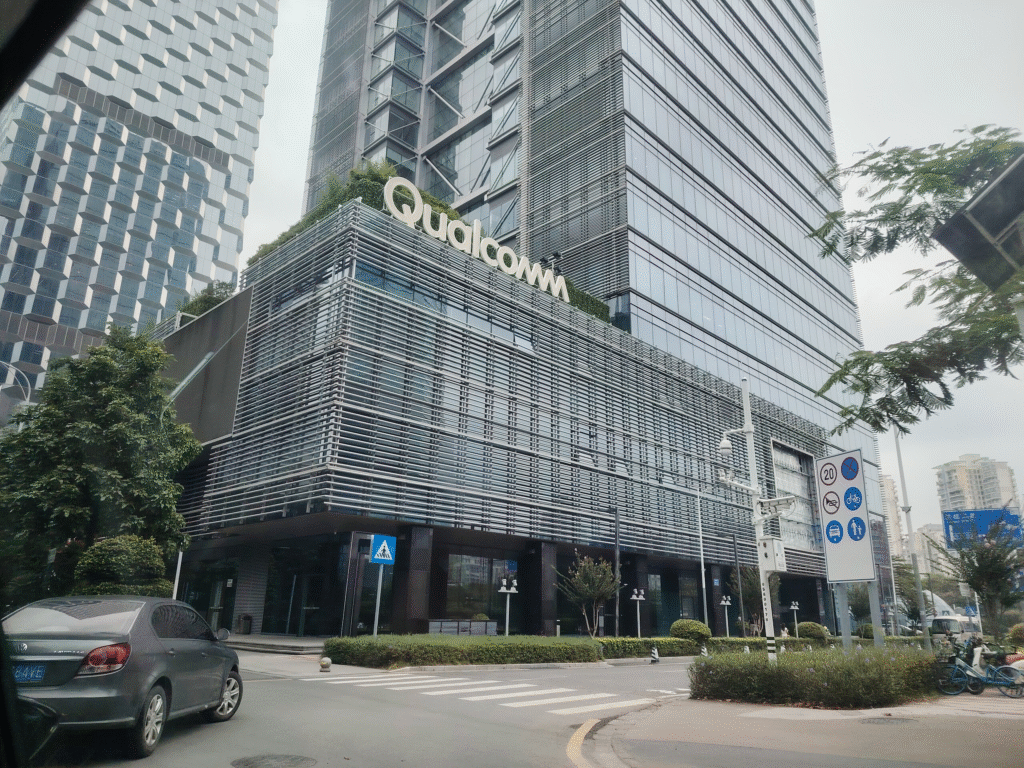
Tipping a deal
Tipping a deal is a series where the author recommends a M&A deal on a company that he engages with in life. This is the second article of such a series. Qualcomm designed the Snapdragon chip, present in Samsung phones.
Qualcomm shares jumped by more than 20% on October 27th as they announced its decision to re-enter the AI datacenter market (a failed joint venture with Microsoft in 2017 was the first entrance) with new products: AI200 & AI250 chips should rival Nvidia and AMD.
The pivot to this market comes as its widely believed the market will continue to grow aggressively throughout this decade. Additionally, the company will want to diversify past its current revenue sources: Licensing of IP and the royalties of electronics in primary consumer segment products. The latter is waning down as mobile device growth is slowing down; losing Huawei as a customer & Apple designing their own chips for its products.
Within the consumer segment, power efficiency of electronics designed by Qualcomm is key to both the consumer audience and Qualcomm as a company.
While Nvidia GPUs (and AMD GPUs) are the primary processors used for AI model training. Qualcomms AI processors possess the edge in powerefficiency, in a bid to differentiate itself; Datacenter hosts running LLMs (Large Language Models: Claude, Chatgpt, Gemini) are facing increasing costs where Qualcomm offers a solution. Not only does this address the issue of increasing energy costs, it also addresses the issue of energy scarcity and grid (in)availability.
Still, Qualcomm has to compete with Nvidia, AMD, Intel & Google (if Google allows the sale of its custom processors to Meta). The AI inference (total addressable) market is expected to reach $350 billion by 2032 and is currently (2025) valued at $104 billion. Assuming 50% of this market to cover the GPU market and a shy constant market share of 6%, this would add $48 billion over 2026-2032 on top of their $50 billion x 7 = $350 billion annually. Assuming an aggressive market share of 14% would add $111 billion instead.


In other words, financial impact on the bottom line would be limited unless Qualcomm achieves high netprofit and gross margins on their AI products (processors, accelarator cards, server racks) which could potentially significantly double or triple earnings which have fallen from $13 billion in 2022 to $5.5 billion as of now. To do so, Qualcomm needs to aggressively increase its market share and achieve a double-digit marketshare by 2032 in order to make an impact on its earnings.
Pivot to an AI niche
Due to the uncertainty of the market, the conditions for financial success and a competitive environment…I believe that Qualcomm can instead become a leader in a different AI Inference niche: Local AI agents & LLM hosting hardware.
As companies want to apply Artificial Intelligence in their respective industries, AI agents will emerge in automation, robotics industries & workfields involving software. These AI agents involve LLMs that will need to be hosted, in the cloud or locally. Local hosting offers lower latency (deemed important in automation & robotics); better data security; reduced long term costs as tokens are not charged & full control & customisation.
It is expected that institutions dealing with large amounts of protected data of its clients – such as healthcare institutions & financial institutions – would move to local hosting as well as manufacturing industries.
This market is a submarket of the Edge AI market, which regards local running LLMs on vehicles, smartphones and more. This market is estimated to be $27 billion in 2025 and estimated to grow to $270 billion by 2032. Qualcomm is already present in this market with IP licensing of its 5g and IoT technology.
An early step forward would mean that Qualcomm is far ahead of its competitors, allowing it to acquire a large market share. Achieving a 20% marketshare and mantaining such would contribute $232 billion to $350 billion of revenues over the same time period. This is more than double the predicted revenues of Qualcomms participation in the AI inference market with a constant market share.

That is why I believe Qualcomm should focus on developing technology exclusively for the Edge AI market and becoming a software & hardware leader for local LLM running, from user-friendly software integration to the supply of standardised cables and modular corporate racks, in addition to specialised NPUs (Neuron Processor Unit) which are more powerefficient than GPUs. Thus, Qualcomm becomes a fullstack technology provider.
An acquisition for technology
To inherit the capability of becoming a fullstack provider, it can do so through an acquisition. This capability covers the ability to design and produce (or possibly outsource):
- Processors (NPUs, GPUs, CPUs) & Memory Storage (VRAM, SSD)
- Racks
- Cooling equipment
- Power solutions
This means that companies with datacenter infrastructure solutions should be the target, with two possible companies being:
- Jabil [Ticker: JBL]: An engineering company that develops products for various industries from healthcare to energy to automation to semiconductors & data centers.
- Flex [Ticker: FLEX]: An advanced manufacturing company that is active in the industrial, automotive, cloud, healthcare, consumer, data center indsutries and more.
Datacenter infrastructure is estimated to be responsible for approximate 25% of their revenue and it is thought to be growing as the market is only growing. Flex & Jabil reported $22B & $23B of revenue over the last fiscal year, respectively. Their net profit are within the same magnitude as Flex reported $876 million and Jabil reported $657 million. Operating margins both lie around 5% while Flex has a 3% profit margin & Jabil a 2.2% profit margin. However, Jabil has managed to increase quarterly revenue with 2 billion dollars over the past 2 quarters while Flex only records 4% revenue growth vs Jabils 18% revenue growth.
This might explain the vast difference in Price-to-book ratio 15 for Jabil vs 4.32 for Flex. Nonetheless, an acquisition of any company would aim to disrupt the operations of the company concerning its datacenter sales in the long term to provide Qualcomm with the possibility to scale its manufacturing and distribution capabilities for its fullstack Edge AI arm.
Simultaneously could the acquisition improve costmanagement of the server-racks that Qualcomm is set to offer for its datacenter lineup by incorporating existing designs of any company and centralising design & production. In addition could Qualcomm include the services of its acquired company in its sales & services of its AI datacenter lineup to customers.
With Flex its more conservative revenue estimates, lower price-to-book ratio (4.6) and lower market cap ($25 billion), the acquisition of Flex would cost less in comparison to Jabil. If possible, the datacenter division or the overshadowing departments could be acquired to prevent an increase in headcount of activities which are not related to Qualcomm its priorities, activities or its identity.
With a cash reserve of $10 billion and a free cash flow of $12 billion, there would be insufficient funds to acquire Flex for a total compensation of $30 billion – assuming a 20% premium – within a short term period. Qualcomm could instead acquire the data center infrastructure division at a much higher premium – due to massive growth and dedicated investment injections – but at a lower total cost or enter a credit agreement with a financial lender to finance its acquisition.
Therefore, the final recommendation is the acquisition of Flex by Qualcomm.
*credits to: 高通深圳分公司 / Wikimedia Commons

Geef een reactie